
Is your website limited to just the visible part?
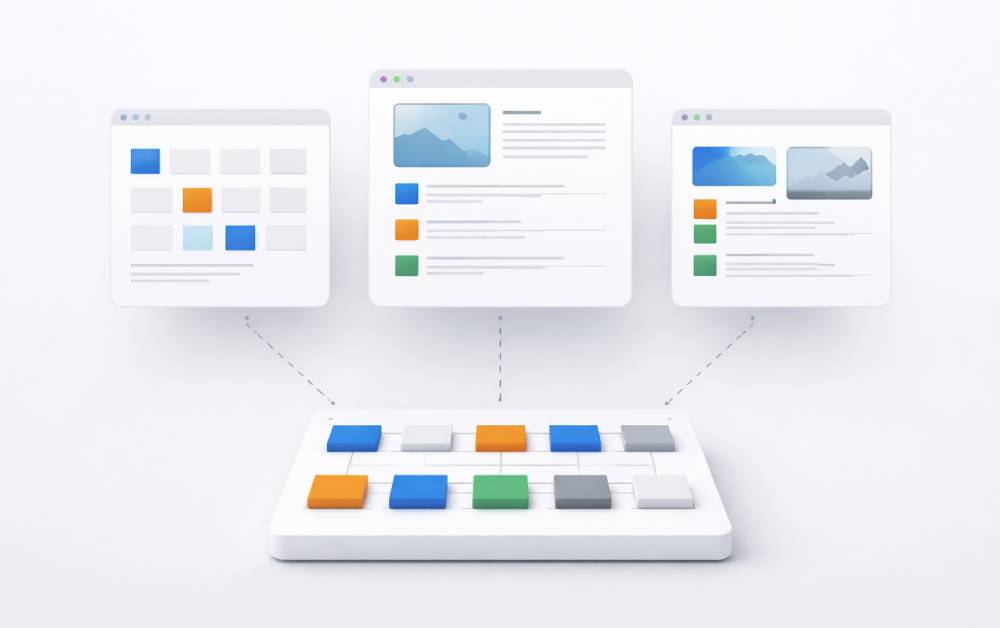
Most websites are perceived as consisting only of the visible pages: homepage, about us, contact... If the necessary pages are ready, the website is considered complete. However, a website is actually much more than that. The real difference lies in the system behind these pages.
Limitations of Page-Based Structure
Many websites manage their content on a page-by-page basis. This means that content can only be found where it was created.
If you want to use it elsewhere:
- You need to recreate the content.
- You need to copy it.
- You need to rearrange it.
This approach works for small projects.
But as the site grew:
- The same content can become different in different places.
- Updates become more difficult.
- Content consistency is compromised.
As a result, content management is becoming increasingly complex.
What is a Website Actually?
A website isn't just made up of pages, as many people think.
Essentially, a website is an interface through which data is presented to the user.
If your content:
- If it is not kept in a central structure
- If it cannot be reused on different pages
- If it cannot be adapted to the needs
The problem is not in the design, but in the infrastructure.
Data-Driven Approach
This is where the difference in approach emerges.
Modern content management systems like Webayt, instead of tying content to pages, allow for:
- It manages in a centralized structure.
- Makes it reusable on different pages.
- It presents options that can be filtered according to needs.
In this way:
- Content reproduction is eliminated.
- Updates are done from a single point.
- The system doesn't become more complex as it grows.
A Simple Scenario from Real Life
Imagine you are creating content.
- It can be listed on the blog page.
- It can be featured on the homepage.
- They can be displayed filtered on different pages.
You don't need to recreate the content for all of this. A single piece of data can create multiple use cases.
Why is this important?
Creating content takes time. However, the real time loss occurs in producing the same content over and over again. Seemingly small repetitions become a significant operational burden over time. With the right system:
- You save time.
- You maintain content consistency.
- You simplify the management process.
A website isn't just the pages you see. Its true value lies in the system behind those pages. Is your site only what's visible, or is there a system running behind it?
Similar Content That Might Interest You

WEBAYT PACKAGES
Choose the Webayt package that suits your needs.
Easily determine the most suitable initial, management, and development option for your website by reviewing Webayt's content management system packages.
- Package options to suit different needs.
- Content management, SEO, and multilingual infrastructure.
- Scalable solution for corporate web projects.
ADDITIONAL SERVICE
Get professional help to keep your website up to date.
You can benefit from our professional management services for your website's content management, updates, and SEO-focused optimizations.
- Page, content and module updates
- SEO-focused content editing.
- Monthly scheduled website management.
Frequently Asked Questions
What is corporate web design?
Corporate web design is the process of designing and developing a website that professionally reflects a company's brand identity, services, and goals in the digital environment.
How long does it take to create a corporate website?
The preparation time varies depending on the scope of the project, the number of pages, design requirements, and content. A standard corporate website can usually be ready to go live within a few weeks.
What determines the price of a corporate website?
Website pricing can vary depending on design scope, number of pages, custom development needs, multilingual support, content entry, and technical specifications.
Is SEO included in the web design service?
An SEO-friendly infrastructure is a crucial part of the corporate web design process. However, regular SEO efforts, content creation, and backlink building can also be planned separately.
Can the website be updated later?
Yes. On corporate websites with a content management system, pages, blog posts, images, and other content can be easily updated later.
Is it possible to create a multilingual website?
Yes. With multilingual websites, you can publish your content in different languages and reach international users more easily.
Why is a mobile-friendly website important?
Since the majority of users access websites from mobile devices, mobile compatibility is of great importance in terms of user experience, SEO, and conversion rates.